
Investment Guide
401(k) to Gold IRA Rollover: Step-by-Step Guide (2026)
A 401(k)-to-Gold IRA rollover preserves tax-deferred status when processed as a direct transfer, bypassing the mandatory 20% federal withholding applied to indirect distributions. Custodians such as Equity Trust Company accept rollovers from most employer-sponsored plans, with the conversion completing in 7-21 business days depending on the releasing plan administrator. Annual custodial fees typically range from $75 to $300, separate from storage costs at an IRS-approved depository.
Updated: October 2, 2026
Quick Answer: Yes — the IRS permits rolling over a 401(k) into a self-directed Gold IRA when you separate from your employer or qualify for an in-service distribution at age 59½. A direct trustee-to-trustee transfer is tax-free, penalty-free, and avoids the 20% mandatory withholding that applies to indirect rollovers. The process typically completes in 10–14 business days. IRA-eligible gold must meet .995+ purity under IRC §408(m); approved coins include American Gold Eagles and Canadian Maple Leafs. Annual costs run $225–$650 (custodian + storage fees) vs. $0–$25 for a standard IRA.
Top Gold IRA Companies 2026
Independently reviewed and ranked by our editorial team

- Lifetime Support
- Price Match Guarantee
- Free Gold IRA Kit

- A+ BBB Rating
- Excellent Reviews
- Buyback Guarantee

- 20+ Years Experience
- Educational Resources
- Transparent Fees

- Texas Depository
- No Quibble Policy
- IRA Specialists

- Low Minimum
- Fast Setup
- Price Protection
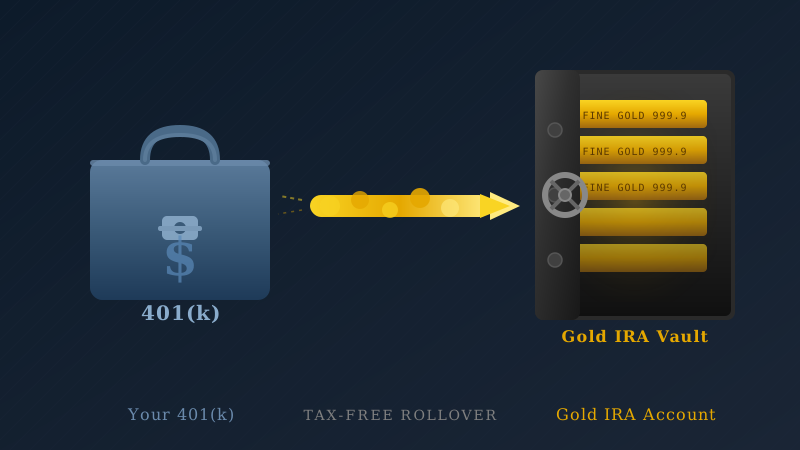 401k to Gold IRA rollover process diagram
What Is a Gold IRA?
A gold IRA is a self-directed IRA (SDIRA) that holds IRS-approved physical precious metals in an approved depository, preserving your tax-deferred status while adding a proven inflation hedge. Unlike a gold ETF held in a standard brokerage IRA, a gold IRA holds actual physical metal. Your chosen gold IRA custodian administers the account and contracts with an IRS-approved depository to store your metals — you select the depository, but IRS rules under IRC §408(m) require third-party custody.
Key features of a gold IRA include:
- It is a self-directed account — you direct investments into IRS-approved alternative assets like gold bullion (.995+ purity gold bars), gold coins (American Gold Eagles, Canadian Maple Leafs), silver, platinum, and palladium.
- Your custodian stores all physical gold at an IRS-approved depository — if you take personal possession, the IRS immediately treats the full account value as a taxable distribution plus penalties.
- Can be structured as a traditional IRA (tax-deferred) or Roth IRA (funded with after-tax dollars).
- Your gold IRA legally holds only IRS-approved metals: gold bars at .995 purity or higher, American Gold Eagles, Canadian Maple Leafs — your custodian rejects any purchase outside these standards. Numismatic and collectible coins are prohibited.
Can You Buy Physical Gold in a 401(k)?
Standard employer-sponsored 401(k) plans prohibit physical gold ownership — making a rollover to a self-directed gold IRA the only IRS-compliant path to hold real bullion in your retirement account. Most 401(k) plans restrict investments to mutual funds, index funds, and target-date funds selected by plan administrators. Physical gold bullion, gold bars, and gold coins are not eligible assets under most 401(k) plan documents, regardless of how a plan provider markets “precious metals exposure.”
What you may see inside a 401(k) — a “gold fund” — is typically a gold ETF (like GLD or IAU) or a mining-stock basket, not physical metal in a vault. The distinction matters:
- Gold ETF inside 401(k): Paper exposure to gold price only; no physical ownership; subject to fund management fees and counterparty risk.
- Physical gold in a gold IRA (SDIRA): Actual gold bars or coins stored in a Brink’s or Delaware Depository vault; IRS-approved under IRC §408(m); held in your name; eligible for in-kind distribution at retirement.
A self-directed gold IRA eliminates this restriction entirely. By rolling your 401(k) into an IRS-compliant gold IRA, you gain the ability to own IRS-approved gold bars (.995 purity) and coins held at an approved depository — while preserving your tax-deferred status. A direct trustee-to-trustee transfer triggers zero taxes and zero penalties.
Why Consider a 401k to Gold IRA Rollover?
A 401k to gold IRA rollover delivered documented downside protection in 2008 and 2022 — but adds $225–$650 in annual fees and eliminates dividend income. Evaluate both sides with specific data before deciding.
During the 2008 financial crisis, the S&P 500 declined 37% while gold gained 5.5% (World Gold Council). Over the 20-year period 2004–2024, gold averaged an 8.8% annualized return, outperforming the Bloomberg U.S. Aggregate Bond Index (4.1%). In 2022 — when the S&P 500 fell 19.4% and bonds lost 13% — gold declined only 0.3%, demonstrating its documented negative correlation with equity drawdowns.
Documented benefits of a 401k to gold IRA rollover:
- Inflation hedge: Gold gained 25% in 2020 as the Fed expanded the money supply by 26%, maintaining purchasing power when fiat currency was debased.
- Negative correlation to equities: During S&P 500 drawdowns of 20%+, gold averages a 6.3% gain — providing a portfolio buffer during market crashes (World Gold Council data).
- Tax-advantaged structure: A direct rollover preserves tax-deferred status — zero taxes triggered by a trustee-to-trustee transfer.
- Recommended allocation: Financial planners who recommend gold typically suggest a 5%–15% portfolio allocation as a hedge, not a complete replacement for equities.
What Are the Downsides of a Gold IRA?
Gold IRAs carry five documented disadvantages investors must weigh before rolling over:
- Higher annual costs: Standard IRAs cost $0–$25/year; gold IRAs average $225–$650/year in combined setup, custodial, and storage fees — a cost drag that compounds over decades.
- No income generation: Physical gold pays no dividends or interest, unlike bond funds or dividend stocks in a standard IRA.
- Illiquidity at RMD age: Under the SECURE 2.0 Act of 2022, Required Minimum Distributions (RMDs) begin at age 73. For a gold IRA, this means liquidating metal or taking an in-kind distribution (requiring a qualified appraisal).
- Dealer spread on buy/sell: Dealers charge a premium above spot price when you buy and buy back below spot when you sell — a spread typically ranging from 3%–10%.
- No FDIC/SIPC protection: Physical metals in a depository carry no government insurance guarantee, unlike bank deposits (FDIC) or brokerage accounts (SIPC).
A gold IRA is best used as a diversification tool (5–15% of portfolio), not a complete replacement for a traditional retirement portfolio.


Gold IRA Rules You Must Know
IRS rules — specifically IRS Publication 590-A and IRC §408(m) — govern every aspect of a gold IRA: eligible metals (minimum .995 purity for gold bars), approved storage (no home storage), and rollover timing (60-day window for indirect rollovers under IRC §408(d)(3)). Violating these rules converts your rollover into a taxable distribution, triggering ordinary income tax plus a 10% early withdrawal penalty under IRC §72(t) if you are under age 59½. An indirect rollover also triggers 20% mandatory federal withholding — another reason to use direct rollovers exclusively.
Eligible Precious Metals
- Your gold IRA legally holds only IRS-approved metals under IRC §408(m): gold at .995 minimum purity (bars from NYMEX/COMEX-approved refiners), silver at .999, platinum and palladium at .9995.
- IRS-approved coins include: American Gold Eagles, American Gold Buffalos, Canadian Gold Maple Leafs (1 oz, .9999 fine gold), and Austrian Gold Philharmonics.
- Your custodian legally cannot accept numismatic or collectible coins — they are classified as “collectibles” under IRC §408(m)(2) and are prohibited regardless of gold content.
Storage and Custody
- Your custodian stores all physical metals at an IRS-approved depository — options include Delaware Depository, Brink's, and HSBC — under IRS Rev. Proc. 92-93 depository standards.
- You choose between segregated storage (your metals stored separately, ~$150–$200/year) or commingled storage (pooled with others, ~$100–$150/year).
- The home storage gold IRA is not IRS-compliant — IRS rules under IRC §408(m) immediately convert the full account value into a taxable distribution if you take personal possession. This is confirmed in IRS Private Letter Ruling 2004-38.
Direct Rollover vs Indirect Rollover
When moving funds from a 401k to a gold IRA, you'll usually choose a direct rollover. If funds are already in an existing IRA, you may use a direct transfer between custodians.
Direct Rollover (Recommended)
Choose a direct rollover: it moves funds trustee-to-trustee, avoids 20% mandatory federal withholding, and eliminates the 60-day deadline risk. This is the only method that triggers zero taxes and zero penalties.
- Money moves via trustee-to-trustee transfer directly from your 401(k) plan administrator to your gold IRA custodian — funds never pass through your hands.
- No 20% mandatory federal withholding, no income taxes, no IRS Form 1099-R taxable event.
- Your gold IRA custodian provides a Letter of Acceptance (LOA) to your plan administrator — this document initiates the transfer.
- If your 401(k) allows in-service withdrawal (while still employed), you may roll over a portion without leaving your job — verify eligibility with your plan administrator.
Indirect Rollover (High Risk — Use With Caution)
- Your plan administrator issues a check to you — triggering 20% mandatory federal withholding automatically. You receive only 80% of your balance in hand.
- You must deposit the full original amount (including the 20% withheld by the IRS) into your gold IRA within the 60-day rollover rule window under IRC §408(d)(3).
- Missing the 60-day deadline converts the entire distribution to ordinary taxable income plus a 10% early withdrawal penalty under IRC §72(t) if you are under age 59½.
- You receive IRS Form 1099-R reporting the distribution — creating a tax filing obligation regardless of whether you complete the rollover on time.
How to Open a Gold IRA in 5 Steps
The rollover process is simpler than you think
Choose a Company
Research and select a reputable Gold IRA company that fits your needs.
Open Your Account
Complete the application with a qualified custodian.
Fund Your Account
Rollover from existing 401k or IRA — tax-free with direct rollover.
Select Your Metals
Choose IRA-eligible gold, silver, or other precious metals.
Secure Storage
Metals shipped to an IRS-approved depository.
Step-by-Step: How to Roll Over Your 401(k) to a Gold IRA
A 401(k) to gold IRA rollover takes 2–4 weeks and follows five concrete steps:
- Select a gold IRA company and custodian (Days 1–3): Choose a company with an A+ BBB rating and transparent fee schedule. Request their written fee disclosure before signing. Verify that your chosen custodian is IRS-approved.
- Open your self-directed IRA account (Days 3–7): Complete paperwork including beneficiary designations. Your custodian assigns your new SDIRA account number and provides a Letter of Acceptance (LOA) for your plan administrator.
- Initiate the rollover with your 401(k) plan administrator (Days 7–14): Contact your HR department or plan administrator. Specify “direct rollover” explicitly — not an indirect distribution. Submit the LOA from your gold IRA custodian. The plan administrator wires funds directly to your custodian. You receive IRS Form 1099-R showing a $0 taxable amount.
- Select IRS-eligible metals (Days 14–21): Once funds arrive, choose from IRS-approved products: American Gold Eagles, Canadian Gold Maple Leafs (.9999 fine), or gold bars (.995+ purity from NYMEX-approved refiners). Your dealer quotes spot price plus dealer premium (typically 3%–7% above spot).
- Confirm depository storage (Days 21–28): Metals ship insured to your IRS-approved depository. You receive a storage confirmation showing your specific holdings (segregated or commingled).
- ✓ Request a direct rollover — not indirect distribution
- ✓ Use trustee-to-trustee transfer (funds never touch your hands)
- ✓ Confirm your custodian is IRS-approved
- ✓ Purchase only .995+ purity gold or IRS-approved coins
- ✓ Confirm your depository is IRS-approved (not home storage)
Costs, Fees & Storage: What You'll Actually Pay
Gold IRA costs typically total $225–$650 per year — significantly higher than a standard IRA ($0–$25/year). Here is the complete breakdown:
| Fee Type | Typical Range | Notes |
|---|---|---|
| Setup Fee | $50–$150 | One-time; often waived for accounts $50K+ |
| Annual Custodial Fee | $75–$300 | Paid to the IRS-approved custodian for administration |
| Storage Fee | $100–$200/year | Segregated ($150–$200) vs. commingled ($100–$150) |
| Dealer Spread | 3%–10% over spot | On metal purchases and buybacks — reduces effective return |
| Wire Transfer Fee | $25–$50 | Per transaction for fund movements |
Always request a complete written fee schedule before opening an account. Some companies advertise “no fees” but embed costs in wider dealer spreads. Ask for the explicit all-in annual cost (custodial + storage), which typically ranges $175–$500/year. Annual contribution limits for 2026: $7,000 ($8,000 if age 50+) — rollover amounts are not subject to these limits.
Augusta Precious Metals — #1 Rated for 401(k) Rollovers
A+ BBB rating, zero customer complaints, and a dedicated rollover team. Augusta guides you through every step of the trustee-to-trustee transfer — from paperwork to IRS-approved depository storage.
Request Your Free Gold IRA Guide →Taxes, Penalties & RMDs: What to Know Before You Roll Over
A correctly executed direct rollover triggers zero taxes. An indirect rollover missed past the 60-day window becomes a fully taxable distribution plus a 10% penalty (IRC §72(t)) if you are under age 59½. Full tax picture:
- Traditional gold IRA: Contributions may be tax-deductible (income limits apply). Growth is tax-deferred. Withdrawals taxed as ordinary income at your rate in retirement.
- Roth gold IRA: Contributions made with after-tax dollars. Qualified withdrawals are tax-free after age 59½ and a 5-year holding period. No RMD requirement during the owner's lifetime.
- Direct rollover: Zero taxes triggered. You receive IRS Form 1099-R showing a $0 taxable amount. This is the recommended approach.
- Indirect rollover failure: Missing the 60-day deadline converts the distribution to ordinary taxable income plus 10% early withdrawal penalty under IRC §72(t) if under age 59½.
- Required Minimum Distributions (RMDs): Under the SECURE 2.0 Act of 2022 (§107), RMDs from traditional gold IRAs begin at age 73. Unlike paper assets, RMDs from a gold IRA require selling metal for cash or taking an in-kind distribution (requiring a qualified appraisal and depository coordination).
- Early withdrawal penalty: Distributions before age 59½ are subject to ordinary income tax plus 10% additional tax under IRC §72(t), unless a specific exception applies.

Should You Move Your 401(k) to Gold? Who It's Right For
A 401k to gold IRA rollover makes the most financial sense for investors within 10–20 years of retirement who have $50,000+ in retirement assets and want documented inflation protection. It is generally unsuitable as a sole retirement vehicle.
| Gold IRA May Be Right For You If… | Gold IRA May NOT Be Right If… |
|---|---|
| ✓ You have $50,000+ in retirement assets | ✗ Your total retirement savings are under $25,000 |
| ✓ You are within 10–20 years of retirement | ✗ You are early in your career (30+ years to retirement) |
| ✓ You want inflation hedge (5%–15% allocation) | ✗ You need income-generating assets (gold pays no dividends) |
| ✓ Your 401(k) is over-concentrated in equities | ✗ Annual fees ($225–$650/year) are a budget constraint |
| ✓ You want tangible asset protection | ✗ You may need liquidity before age 59½ |
Fidelity 401(k) to Gold IRA: What You Need to Know
Fidelity does not offer a self-directed gold IRA holding physical precious metals. Fidelity IRAs can hold gold ETFs (like SPDR Gold Shares / GLD) — but not physical gold bars or coins in IRS-approved vaults. If your 401(k) is administered by Fidelity, you can initiate a direct rollover from your Fidelity 401(k) to a separate gold IRA custodian (Augusta, Goldco, Birch Gold, etc.) without penalty, following the trustee-to-trustee transfer process described above. Fidelity's plan administrators are experienced with processing these rollover requests and typically require a LOA from your receiving custodian.
How to Choose a Reputable Gold IRA Company
Evaluate gold IRA companies on five criteria: BBB rating (A+ minimum), fee transparency, storage options, buyback policy, and minimum investment threshold — the factors that most directly affect your long-term net return.
- BBB Rating (A+ minimum): Check the Better Business Bureau rating and complaint history. Augusta, Goldco, Birch Gold, Noble Gold, and American Hartford Gold all hold A+ ratings.
- Fee transparency: Demand a written all-in fee schedule: setup fee, annual custodial fee, storage fee (segregated vs. commingled), and dealer spread range before signing anything.
- Storage options: Confirm which IRS-approved depositories they use (Delaware Depository, Brink's, etc.) and whether they offer segregated storage.
- Buyback policy: A guaranteed buyback program at competitive (near-spot) prices is essential for liquidity at retirement or during RMD periods.
- Minimum investment: Ranges from $10,000 (Birch Gold, AHG) to $50,000 (Augusta). Choose a company whose minimum fits your rollover amount.

Allocation Strategy
Financial planners who recommend gold typically suggest a 5%–15% portfolio allocation — sufficient to provide inflation protection and equity correlation benefit without eliminating dividend income or incurring excessive fee drag. For a $500,000 retirement portfolio, this equates to $25,000–$75,000 in a gold IRA. Investors with higher allocations (20%+) typically have strong inflation concerns and shorter time horizons. Always consult a CFP® before making rollover decisions.
Common Mistakes to Avoid
- Using an indirect rollover without replacing withheld taxes.
- Missing the 60-day rule, leading to penalties.
- Attempting to take physical possession of IRA metals.
- Buying non-eligible or collectible coins.
- Working with an unverified provider.
Key Takeaways for a Successful Rollover
- Choose a reputable gold IRA company with a compliant custodian.
- Prefer a direct rollover from your 401k to avoid withholding and reduce tax implications.
- Buy only eligible precious metals meeting IRS rules.
- Use an IRS-approved depository and never take personal possession.
- Understand whether a traditional or Roth structure best fits your tax strategy.
Best Gold IRA Rollover Companies of 2026
Our editors rank Gold IRA companies on five measurable criteria — BBB rating, fees, buyback spread, storage options, and minimums — and disclose affiliate relationships separately. The four providers below cover the widest range of investor needs.
| Company | Min. Investment | Setup Fee | Annual Fee | Storage | BBB | Best For |
|---|---|---|---|---|---|---|
| Augusta Precious Metals | $50,000 | $50 (waived $50K+) | $80/yr | $100/yr segregated | A+ | Large accounts ($50K+) |
| Goldco Precious Metals | $25,000 | $50 | $80/yr | $150/yr | A+ | Best buyback program |
| Birch Gold Group | $10,000 | $50 | $75/yr | $100/yr | A+ | Low minimum / first-timers |
| American Hartford Gold | $10,000 | $0 (first year) | $75/yr | $100/yr | A+ | Lowest barrier to entry |
IRS-Approved Gold for IRAs: Purity, Coins & Bars (IRC §408(m))
IRA-eligible gold must meet strict purity and fineness standards set by the IRS under IRC §408(m)(3). Your custodian is legally required to reject any purchase that does not meet these standards.
| Coin / Bar | Fineness / Purity | IRA Eligible? | Notes |
|---|---|---|---|
| American Gold Eagle | 91.67% (22-karat) | ✓ Yes | Exempt under IRC §408(m)(3)(A) despite below-.995 purity |
| Canadian Gold Maple Leaf | .9999 fine (24-karat) | ✓ Yes | LBMA Good Delivery listed; most popular IRA coin globally |
| Austrian Gold Philharmonic | .9999 fine | ✓ Yes | LBMA accredited; widely accepted by U.S. custodians |
| Gold Bars (NYMEX/COMEX refiner) | .995+ fineness | ✓ Yes | Must be from NYMEX- or COMEX-approved assay; most common bar sizes: 1 oz, 10 oz, 1 kilo |
| Krugerrand | 91.67% (22-karat) | ✗ No | Does not qualify under IRC §408(m); not included in the U.S. Mint statutory exemption |
| Numismatic / Collectible Coins | Varies | ✗ No | Classified as "collectibles" under IRC §408(m)(2); prohibited regardless of gold content |
The IRS does not approve gold based on brand — it approves based on fineness and manufacturer accreditation. Always confirm eligibility with your custodian before purchasing. Spot price at purchase plus the dealer premium (typically 3%–8% for coins; 1%–3% for bars) determines your true cost basis.
What Investors Are Saying
"Rolling over my 401k to a gold IRA was one of the best financial decisions I've made. The process was seamless and I feel much more secure about my retirement."

"I was hesitant at first, but the educational resources helped me understand exactly what I was investing in. Very professional experience from start to finish."

"Good service overall. The transfer took about two weeks but everything was handled professionally. My portfolio feels more diversified now."